
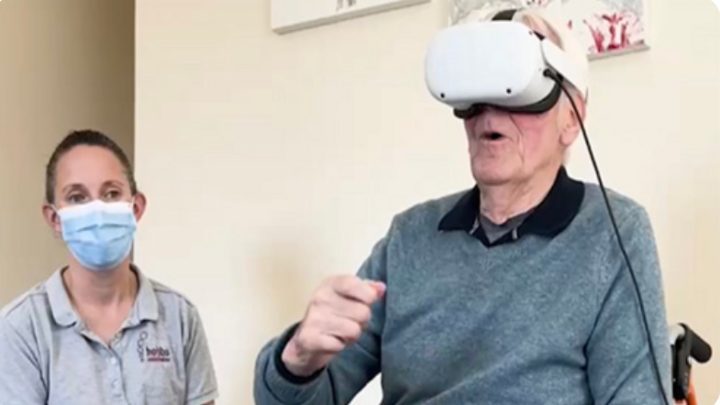
Regaining movement after a stroke takes hundreds of repetitive exercises; maintaining momentum is one of the toughest parts of recovery.
That’s why our clinical research at Princess Royal Hospital in Haywards Heath stands out.
Stroke survivors across Sussex have been testing NeuroVirt, an immersive virtual reality platform designed to turn upper-limb rehabilitation into engaging, interactive games. By gamifying arm, wrist, and hand movements alongside traditional physiotherapy, the team at the hospital are exploring two crucial questions for the future of NHS care:
1️⃣ Does immersive VR motivate patients of all ages to practise more frequently and regain independence faster?
2️⃣ How can digital therapeutics be integrated sustainably and cost-effectively into everyday NHS pathways?
A patient’s perspective
Jon, a patient who took part in the research following a stroke, said: “My left arm weakness affects me a lot. It makes everything hard like eating food, pouring a drink and holding things. I was really interested in trying the VR and had a great time using it. I really wanted to improve how much I can use my arm, and it has been getting better with my therapy and using the VR. Taking part in research was also interesting to me because it helps other people too.”
Innovation in healthcare isn’t just new tech; it’s designing tools that fit human motivation and clinical workflows. Huge credit to the therapists, researchers, and patients at Princess Royal Hospital and across UHSussex helping shape the future of stroke recovery.
Find out how your business can support the Princess Royal Hospital: shane.hickey@nhs.net